
Gunnison Parole vs Probation
Parole and probation are often searched together, but they answer different release questions. Probation usually comes from a court sentence or court order and can follow a local jail case without a state-prison term. Parole follows release from CDOC prison or another parole-eligible state custody path. The local Gunnison Probation Office is not the parole board, and CDOC parole is not the same as a county jail release.
| Supervision type | Who handles it | Best verification path |
|---|---|---|
| Probation | Colorado Judicial Branch, 7th Judicial District | Gunnison Combined Court and Gunnison County Probation Office. |
| Parole | CDOC Division of Adult Parole and State Board of Parole | CDOC offender search and parole-board records or calendar context. |
| Deferred judgment | Court and probation when ordered | Court case record, probation office, and sealing rules if completed and dismissed. |
| Revocation hold | Court, probation, parole, or jail depending on status | Current jail roster, court docket, and supervising agency. |
Verify Gunnison Post-Release Supervision
The cleanest verification path starts with the source that created supervision. A released county-jail detainee may be on probation through a court order. A released state-prison inmate may be on parole through CDOC. A parole hearing date is not proof of release; it means a hearing is scheduled or was scheduled.
- Find the court case through the Colorado docket search or Gunnison Combined Court if probation is suspected.
- Read the sentence, deferred judgment, revocation, or termination entries where available.
- Contact the Gunnison County Probation Office for local probation process questions within public-access limits.
- Search the CDOC offender search by DOCNO or name when parole or state-prison release is suspected.
- Use the parole-board calendar for hearing timing, not as the final status record.
- Use the jail roster if a warrant or revocation arrest may have returned the person to custody.
Gunnison County Probation Office
The Gunnison County Probation Office is located at the Gunnison County Courthouse. The location page lists phone, fax, email, and weekday hours. The broader probation page places Gunnison in the 7th Judicial District, with district administration in Montrose and offices in Delta, Gunnison, and San Miguel County courthouses.
Gunnison County Probation Office
Gunnison County Courthouse
200 E. Virginia Ave
Gunnison, CO 81230
Phone: 970-642-8360
Fax: 970-642-8351
Email: shaun.foli@judicial.state.co.us
Hours listed on the location page: Monday through Friday, 8:00 a.m. to 5:00 p.m.
The district page also describes split midday public hours for district offices, so call before visiting to confirm current walk-in timing.
Gunnison District Supervision Context
The 7th Judicial District probation source gives useful local context. It identifies district probation leadership and staffing and reports district-level averages, including adults and juveniles placed on probation each month, active caseloads, and successful termination percentages. Those figures are district-wide, not Gunnison-only, so they should be read as regional probation context.
Probation confirmation still comes from the court order and probation office. A person released from the Gunnison County Detention Center may have no probation if the case remains pretrial, was dismissed, or ended another way. The court case explains the status.
Colorado Parole Hearings
The CDOC parole-board calendar shows monthly hearing calendars. The page says hearings are subject to change, DOC modifications are available the following business day, hearings are open to the public, and advance arrangements are required. For application or rescission hearings, it directs people to the offender's case manager. For revocation hearings, it directs people to the jail where the offender is located.
The CDOC parole-board calendar source shows hearing-month access and change warnings.
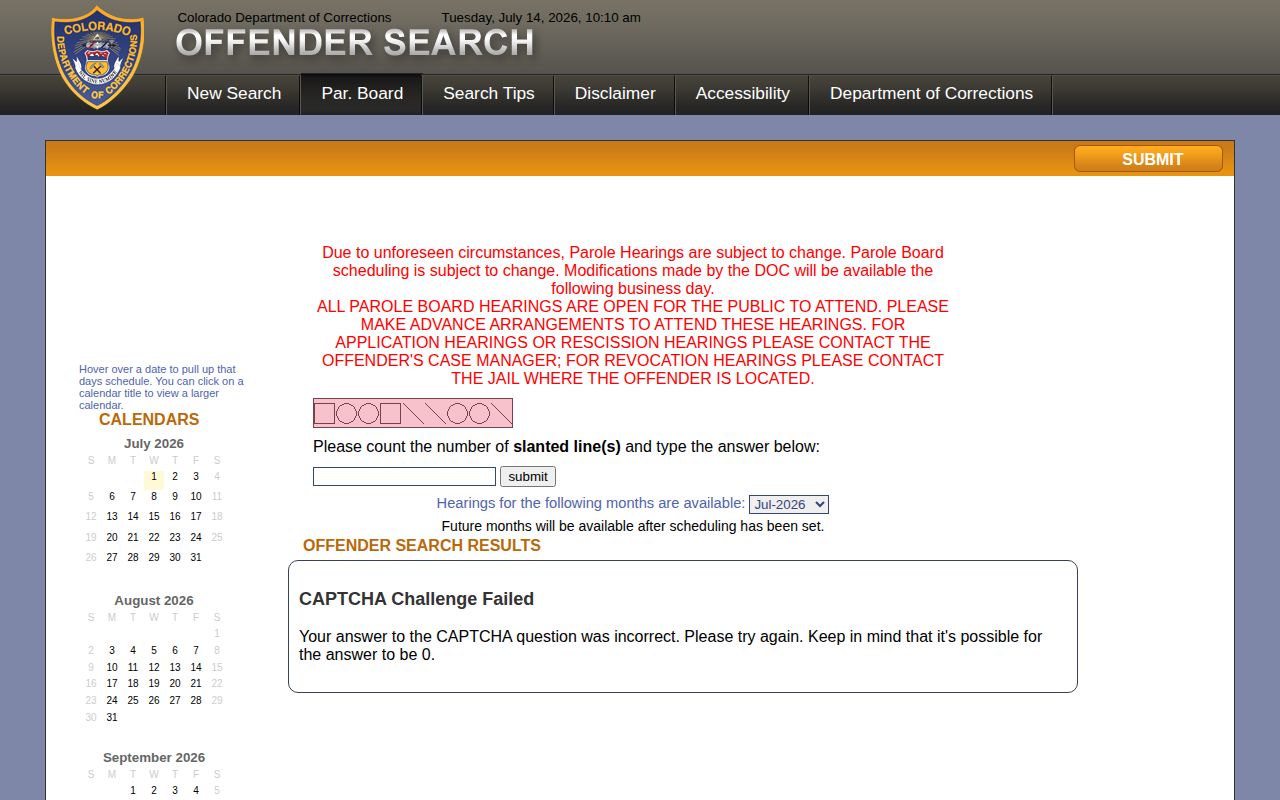
Use the calendar for scheduling context. Use the CDOC offender record and parole agency for current status.
Gunnison Warrants and Absconders
No separate Gunnison County absconder list dedicated to parolees or probationers was found in the official county sources reviewed. The daily roster may show warrant-related custody for current inmates, including in-county or out-of-county warrant language. That does not make the roster an absconder list.
For probation violations, use the court docket and probation office. For parole warrants or revocations, use CDOC, parole contacts, and the jail or court currently holding the person if an arrest occurred.
- Absconder
- A person accused of failing to report or leaving supervision contact.
- Revocation
- A court or parole process that may remove supervision and return the person to custody.
- Discharge
- The end of a sentence or supervision term when the legal authority ends.
How Gunnison Supervision Ends
Probation can end through successful termination, court order, revocation, or other case action. Parole can end through discharge from CDOC supervision, revocation, or further board and agency action. A release from the county jail is not the same as discharge from supervision.
For record correction or public visibility, the correct path depends on where the issue appears: sheriff release record, court case record, CDOC offender record, CBI registry, or federal locator. The Gunnison County released inmates page covers release-record requests and court-record follow-up in more detail.
Gunnison Alternative Sentencing
Gunnison's work-release and weekender materials belong near supervision because they describe court-authorized sentence structures that may look like partial release to a reader. Work or school release is not the same as parole. It is a jail-administered alternative-sentencing program with paperwork that must be completed before the sentence begins. The weekender process requires both court authorization and sheriff authorization, plus no active warrants.
These local programs can appear in roster disposition language. A person may leave the facility for approved work or school while still serving a jail sentence. Confirm the status through the detention center and court order before treating it as completed release or probation.
Gunnison Release Duties
Release from jail can leave court dates, payment duties, no-contact orders, treatment terms, probation intake, or parole reporting. The public jail roster will not list every duty. Court records and supervision offices are the better sources for what must happen next. When CDOC parole is involved, the offender record and parole contacts matter more than the local probation office.
A practical way to separate the paths is to ask what authority imposed the obligation. If the court ordered probation, follow the court and local probation office. If CDOC released the person from prison to parole, follow CDOC and the Board of Parole context.
Gunnison Discharge Records
Discharge means the supervision authority has ended. It is different from release from a jail cell. A person can be out of the Detention Center and still owe probation reporting, parole reporting, registry duties, treatment conditions, or court appearances. A court termination entry or CDOC discharge status is the source to look for when the question is whether supervision ended.
Sealing can affect public access to some court and criminal-justice records after non-conviction outcomes. That does not erase every agency record, and it does not make the jail roster a supervision record. Use the court, probation, parole, and corrections records for the precise status.
Gunnison Hearing Changes
Parole hearing schedules can change, and the CDOC calendar source says DOC modifications are available the following business day. For probation, court dockets and clerk records are the stronger source for hearing changes. Always separate a scheduled hearing from a final release or supervision outcome.
Note: Final supervision status comes from the court, CDOC, or the supervising office.